

As the Accounting Solutions team moves through a busy year-end period and supports clients heading into the new tax year, there are a number of important business and compliance changes to keep on the radar. In this edition, we’ve brought together some of the key updates to be aware of. We hope this provides a helpful overview of what’s changing and what may need your attention. If you would like support reviewing how any of these changes may affect you, please get in touch.
Key Takeaways
- Now is a good time to get year-end ready with your accounts, payroll, and compliance as we head into the new tax year.
- Minimum wage rates increase from 1 April 2026, so businesses should review payroll settings, cashflow, holiday pay, ACC levies, and related pay rates.
- KiwiSaver changes are also coming from 1 April 2026, including an increase in default employer and employee contribution rates to 3.5%, so it is worth checking payroll systems and budgets now.
- Employment law changes took effect from 21 February 2026, including updates to contractor classification, high-income employee dismissal claims, the 30-day rule, and personal grievance compensation.
- ACC CoverPlus Extra is changing from 1 April 2026, with updates to levy calculations, invoicing, cover levels, discounts, and late payment interest.
- Investment Boost may be worth reviewing before 31 March 2026 if you are already planning eligible asset purchases, but timing and asset eligibility are important.
Table of Contents
- Prepare your business for the end of the financial year
- Tax changes that may effect you
- 2026 Employment Relations Act Changes
- ACC CoverPlus Extra changes from 1st April 2026
- Investment Boost Incentive
Prepare your business for the end of the financial year
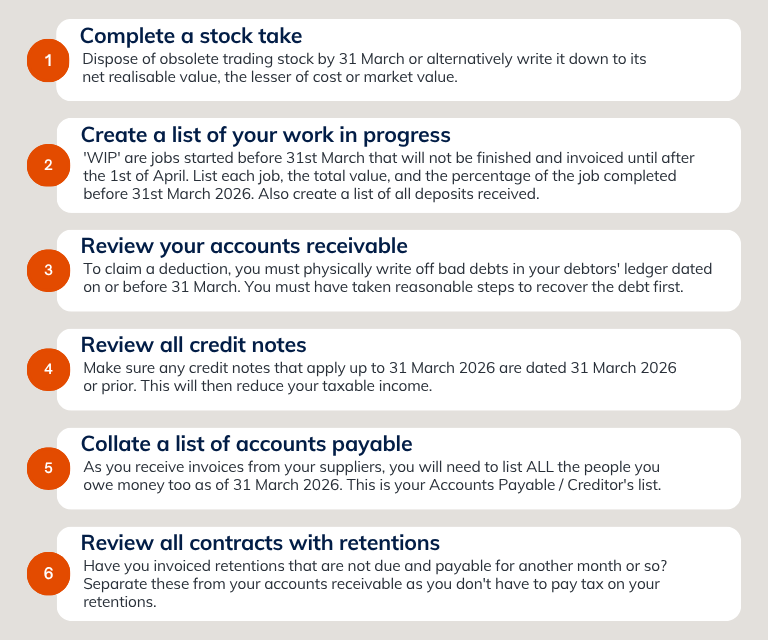
As always we’re here to help you with your business accounts and any queries that you have. To help you prepare in the best possible way, we’ve created this handy ‘to-do’s’ checklist.
2026 Tax changes that my effect you

Minimum wage rates are increasing from 1 April 2026.
The new rates are:
- Adult minimum wage: $23.95 per hour
- Starting-out and training minimum wage: $19.16 per hour
Review your payroll system to make sure it is up to date and compliant with these changes. It’s also worth reviewing the flow-on effects for cashflow, KiwiSaver, ACC levies, holiday pay, and other pay rates.
2026 KiwiSaver Changes
From 1 April 2026, KiwiSaver default contribution rates for both employers and employees will increase from 3% to 3.5%.
There is also an important change for younger workers, with 16 and 17-year-old KiwiSaver members becoming eligible for employer contributions, provided they meet the usual criteria.
Now is a good time to review your payroll settings, budgeting, and employee communications to make sure your business is ready for the change.
2026 Employment Relations Act Changes
From 21 February 2026, several changes to the Employment Relations Act came into force. The key changes are:
Contractor Classification
Employers now have more certainty around when a worker will be treated as a contractor. This will generally apply where:
- there is a written contractor agreement
- the worker can work for others
- the worker can accept or decline work
- the worker is not required to be available at set times
- the worker has the opportunity to seek independent advice
High-Income Employees
Employees earning $200,000 or more per year can no longer raise an unjustified dismissal claim.
30-Day Rule Removed
New non-union employees are no longer required to be employed under a collective agreement for their first 30 days. They can now enter into an individual employment agreement from the start. This applies where an employer already has a collective agreement in place with a union.
Personal Grievances
Compensation will no longer be awarded where a grievance arises primarily because of the employee’s own actions, although this will still be assessed case by case.
ACC CoverPlus Extra changes from 1st April 2026
ACC CoverPlus Extra renewal letters began circulating from Monday, 2 March 2026. If you received your renewal directly from ACC, make sure you carefully review the agreed value, classification unit, and cover period before confirming your policy. There are also several important changes coming into effect from 1 April 2026.
Key changes to note.
- The Working Safer Levy for CoverPlus Extra policy holders will now be based on your level of cover, rather than your IRD summary of earnings. For most customers, this is expected to result in a lower levy.
- From April 2026, the Working Safer Levy and CoverPlus Extra invoice will be issued together, meaning you will receive one invoice each year instead of two.
- The No Claims Discount will be removed from 1 April 2026.
- There will also be changes to the interest charged on late payments. The late payment interest rate will be higher than the instalment interest rate, so if you expect difficulty paying in full by the due date, it may be worth arranging an instalment plan with ACC.
New minimum and maximum levels of cover
| Minimum level of cover | Maximum level of cover | |
|---|---|---|
| Current | $39,492 | $122,232 |
| New: from 1 April 2026 | $40,401 | $125,313 |
Investment Boost Incentive: Its worth reviewing before 31 March 2026
With the current financial year ending on 31 March 2026, now is a good time to consider whether you’re making the most of the Government’s Investment Boost.
Under the current legislation, eligible businesses can claim an additional 20% upfront deduction on the cost of qualifying new depreciable assets in the year the asset is first used or available for use. Standard depreciation can still be claimed on the remaining balance. This can improve cashflow by bringing forward part of your tax deduction.
A key point we’re seeing misunderstood: “new” generally means new to New Zealand – not just new to you. For example, a motor vehicle must be newly registered in NZ (i.e. not previously registered here) to qualify. Buying a used import or a dealer demonstrator that has already been registered in NZ is unlikely to meet the criteria.
If you’re planning asset purchases, timing and eligibility matter. Get in touch if you would like advice tailored to your situation.
| Vehicle Type | Registered to Dealer? | Used in NZ Before Purchase? | Eligible for Investment Boost? |
|---|---|---|---|
| Brand New Vehicle | No (You are first owner) | No | Yes |
| Dealer Demonstrator | Yes | Yes | No |
| Imported Second-Hand Vehicle | No (in NZ) | No (not in NZ) | Yes |